

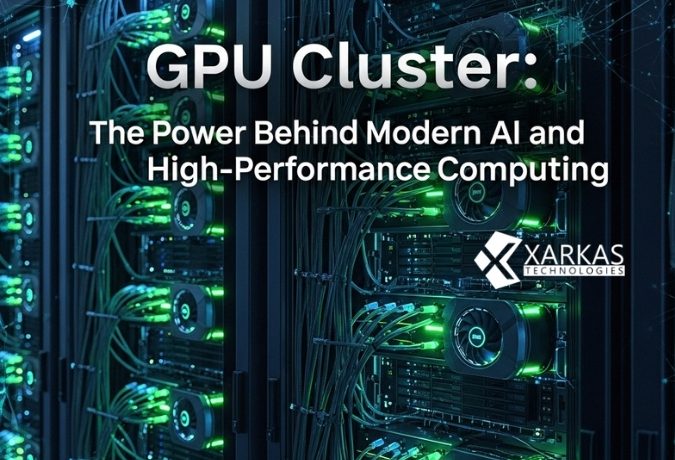
GPU Cluster: The Power Behind Modern AI and High-Performance Computing

Table Of Content
- Introduction
- What is a GPU Cluster?
- Why GPU Clusters are Essential in Modern Computing
- Understanding GPU Architecture
- The Difference Between CPU and GPU
- How GPUs Accelerate Parallel Processing
- What Makes a GPU Cluster?
- Key Components of a GPU Cluster
- Types of GPU Clusters
- How GPU Clusters Work
- Data Distribution and Parallel Computation
- Networking in GPU Clusters
- Applications of GPU Clusters
- Artificial Intelligence and Deep Learning
- Scientific Simulations
- Cloud Computing
- Big Data Analytics
- GPU Cluster vs CPU Cluster
- Performance Comparison
- Cost and Energy Efficiency
- Popular GPU Cluster Frameworks
- Building Your Own GPU Cluster
- Hardware Requirements
- Software and Setup Process
- Cluster Management Tools
- Top Cloud Providers Offering GPU Clusters
- Challenges in GPU Cluster Deployment
- Performance Optimization Tips
- Future of GPU Clusters
- Case Studies of GPU Cluster Usage
- Cost of Running a GPU Cluster
- On-Premise vs Cloud-Based Costs
- Ways to Reduce Costs
- Conclusion
- FAQs
Introduction
In the ever-evolving world of computing, GPU clusters have emerged as a cornerstone of performance, speed, and scalability. Whether it’s training massive AI models, rendering 3D graphics, or performing scientific simulations, GPU clusters make it all possible. But what exactly are they, and why are they so vital?
What is a GPU Cluster?
A GPU cluster is a group of interconnected computers equipped with Graphics Processing Units (GPUs) that work together to perform massive computations in parallel. Instead of relying on a single machine, GPU clusters combine the power of multiple GPUs, making them ideal for handling data-intensive tasks like machine learning and AI workloads.
Why GPU Clusters are Essential in Modern Computing
Modern AI models contain billions of parameters. Training them on a single machine could take weeks—or even months. A GPU cluster can dramatically reduce this time by distributing workloads efficiently, allowing researchers and developers to train complex neural networks faster and more efficiently.
Understanding GPU Architecture
The Difference Between CPU and GPU
While a CPU (Central Processing Unit) handles general-purpose tasks, a GPU (Graphics Processing Unit) is designed for parallel processing. GPUs contain thousands of smaller cores that can handle multiple tasks simultaneously—perfect for deep learning and data analysis.
How GPUs Accelerate Parallel Processing
Think of CPUs as excellent multitaskers but with fewer hands, while GPUs are like having an army of specialized workers doing one job extremely fast. This parallelism is what gives GPU clusters their immense computational power.
What Makes a GPU Cluster?
Key Components of a GPU Cluster
A typical GPU cluster includes:
-
Compute Nodes (each containing CPUs and GPUs)
-
Interconnect Network (for communication)
-
Storage Systems
-
Cluster Management Software
Types of GPU Clusters
-
Small-Scale Clusters: Used for academic or small AI projects.
-
Medium-Scale Clusters: Suitable for startups and research institutions.
-
Large-Scale Clusters: Used by tech giants and data centers for large-scale AI workloads.
How GPU Clusters Work

Data Distribution and Parallel Computation
Tasks are split into smaller parts and distributed across nodes. Each GPU processes a portion of the data simultaneously, and the results are later combined—this massively speeds up computation.
Networking in GPU Clusters
High-speed networks like InfiniBand or NVLink connect the GPUs, ensuring minimal data transfer delays during computation.
Applications of GPU Clusters
Artificial Intelligence and Deep Learning
GPU clusters are the backbone of AI research—used for model training, fine-tuning, and inference.
Scientific Simulations
From weather forecasting to molecular modeling, GPU clusters power advanced simulations that demand extreme computation.
Cloud Computing
Cloud service providers offer GPU clusters for rent, enabling businesses to access immense computing power on demand.
Big Data Analytics
Large datasets are processed faster, enabling quicker decision-making and insights.
GPU Cluster vs CPU Cluster
Performance Comparison
GPU clusters offer 10–100x faster performance in deep learning compared to CPU clusters.
Cost and Energy Efficiency
While GPUs consume more power individually, their performance-per-watt ratio is much better, making them cost-effective for intensive workloads.
Popular GPU Cluster Frameworks
-
NVIDIA CUDA: The most widely used platform for GPU programming.
-
TensorFlow & PyTorch Distributed Training: Allow scaling deep learning workloads across multiple GPUs.
-
OpenCL & ROCm: Open-source alternatives supporting various hardware vendors.
Building Your Own GPU Cluster
Hardware Requirements
You’ll need multiple GPU-equipped nodes, high-speed networking (like InfiniBand), and efficient cooling systems.
Software and Setup Process
Use tools like Kubernetes, Slurm, or NVIDIA’s NCCL for managing workloads across the cluster.
Cluster Management Tools
Tools such as Docker, KubeFlow, and Ansible make deployment and monitoring much easier.
Top Cloud Providers Offering GPU Clusters
-
AWS EC2 – P4 and G5 GPU instances.
-
Google Cloud – A2 and L4 GPU clusters.
-
Microsoft Azure – NDv4 and NC-series for AI workloads.
Challenges in GPU Cluster Deployment
-
High Power Consumption: Requires strong infrastructure and cooling.
-
Complex Setup: Requires expertise in networking and parallel programming.
-
Scalability: Adding more GPUs requires balancing computation and communication overhead.
Performance Optimization Tips
-
Optimize your batch sizes for GPU memory.
-
Implement data parallelism efficiently.
-
Use optimized libraries like cuDNN and TensorRT.
-
Ensure high network bandwidth for faster data transfers.
Future of GPU Clusters
The next era of GPU clusters will focus on AI supercomputers, hybrid clusters combining GPUs with CPUs and even quantum processors. This evolution will redefine performance benchmarks in computing.
Case Studies of GPU Cluster Usage
-
OpenAI uses massive GPU clusters to train models like GPT.
-
NASA leverages GPU clusters for deep space simulations.
-
Netflix employs them for real-time recommendation systems.
Cost of Running a GPU Cluster
On-Premise vs Cloud-Based Costs
-
On-premise clusters require upfront investment in hardware and maintenance.
-
Cloud clusters provide scalability and pay-as-you-go pricing.
Ways to Reduce Costs
-
Use spot instances on cloud platforms.
-
Optimize workloads and use mixed GPU generations.
-
Schedule jobs efficiently to maximize GPU usage.
Conclusion
GPU clusters have become the engine of innovation in artificial intelligence, research, and cloud computing. Their ability to process massive datasets quickly makes them indispensable for businesses and scientists alike. As technology evolves, GPU clusters will continue to break barriers and redefine computational limits.
FAQs
1. What is the main purpose of a GPU cluster?
To perform large-scale parallel computations faster than traditional CPU-based systems.
2. Can I build a GPU cluster at home?
Yes, on a smaller scale, using multiple GPUs connected via high-speed networking.
3. How do GPU clusters improve AI model training?
They distribute data and computation across multiple GPUs, drastically reducing training time.
4. Are GPU clusters expensive?
They can be, but cloud-based options and shared resources make them accessible.
5. What’s the future of GPU clustering technology?
Expect hybrid and AI-driven clusters that integrate quantum and edge computing technologies.


No Comment! Be the first one.